

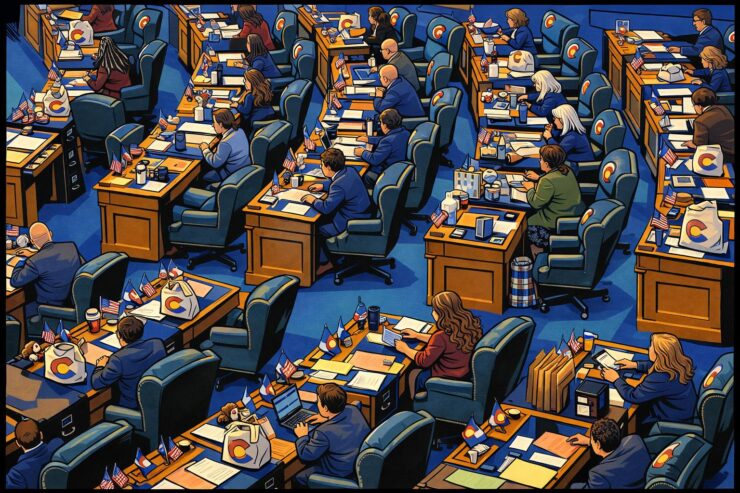
Colorado’s 2026 legislative session starts under a roughly $850 million budget shortfall, which means there’s “essentially no money to spend on new programs and services,” according to The Colorado Sun. And yet — shockingly — the Colorado General Assembly is lining up a buffet of big, complicated ideas anyway: housing “solutions,” health care premium patches, AI regulation, data center rules, union-fee fights, energy mandates, immigration enforcement restrictions, and a grab bag of public safety bills.
So yes. The vibe is: “We’re broke. Also, we have 47 new ways to run your life.”
Welcome to the 120-day Clown Rodeo
Democrats still control the House and Senate, and Gov. Jared Polis has veto power as he enters his last year in office. House Majority Leader Monica Duran says the goal is to make Colorado more affordable, pointing to wages, costs, and “pathways for families.” Democrats say they’ll target health care premiums, homeowners insurance, property taxes, and more price transparency. Republicans say affordability is also their “big goal,” because of course it is — it’s everyone’s goal — it’s just that nobody agrees on what “affordable” means after the legislature is done “helping.”
And that budget shortfall? That’s not background noise. That’s the main character.
Housing: “Local control” dies, again
One of the session’s headline fights is housing — specifically a recurring Denver-area hobby: state government overriding local zoning and calling it “affordability.”
- The HOME Act would let qualifying affordable housing developers, public schools, and universities bypass local zoning laws and build homes on their land.
- Another proposal would make it easier for homeowners to sell off a portion of their property, building on 2024 legislation that eased building accessory dwelling units (ADUs/casitas) — with focus on higher-density areas like Denver metro and Grand Junction.
The Colorado Municipal League is already opposing both, arguing they undermine local decisions and could violate home rule powers. Translation: the state wants to do what it wants, and cities want to do what they want — and we get to pay for the collision.
Also: if lawmakers keep “fixing” housing by forcing more units into communities without matching infrastructure, water, schools, roads, and public safety… what could possibly go wrong? Sure. Totally. Great plan.
Insurance mitigation: they tried fees, got yelled at, now it’s “a new funding mechanism”
Democrats also want to make property insurance more affordable by creating programs to help people protect homes against hail and wildfire — identified as the two largest insurance cost drivers. The legislature tried last year by imposing fees on policies to fund mitigation initiatives, but it was rejected over concerns about new costs on consumers.
House Speaker Julie McCluskie says she’s “looking for a new funding mechanism.” In Colorado-speak, that means: we’re still going to charge you, we’re just workshopping the label.
“Affordability” via price controls (now featuring stadium beer)
Democrats want more consumer price transparency and anti-gouging rules. One new bill would require delivery services like DoorDash and Instacart to disclose when they charge more than the item would cost purchased directly. Rep. Yara Zokaie says consumers can’t make an informed choice if they don’t know there’s a markup.
Then it gets even better: the bill would also cap how much a business can charge “captive consumers” — like buying beer at a baseball game — relative to what it would cost in a restaurant.
We love living in a state where lawmakers see the affordability crisis and respond with: “Have we tried regulating stadium beer prices?” This is like fixing a house fire by banning scented candles.
AI regulation: delayed, lobbied, and headed for Round 3
Colorado is expected to take its third stab at revising a 2024 AI law aimed at preventing discrimination by AI used in hiring, education, health care, and banking. Implementation was delayed to June from February after lawmakers failed to broker a deal among consumer groups, unions, and the business community (including Big Tech) during a special session, and also failed during last year’s regular session.
As written, the law requires companies to assess and disclose when AI is used for consequential decisions and explain outcomes to consumers who dispute them. Sen. Majority Leader Robert Rodriguez says he won’t accept changes that weaken consumer protections. Polis worries Colorado will “go it alone” and discourage tech companies from operating here.
And because the universe has a sense of humor, the Trump administration signed an executive order aimed at banning states from regulating AI by threatening lawsuits and funding cuts. So yes, AI is going to be one of the most-lobbied issues at the Capitol.
Labor: the union-fee fight returns (because why learn?)
For the second year in a row, labor will push a “Worker Protection Act” to repeal a requirement that unions get approval of at least 75% of workers before negotiating union security — meaning workers can be forced to pay fees for representation even if they aren’t union members.
Polis vetoed the same measure in 2025 and says he’ll veto it again in 2026 without major changes. He’s open to reducing the 75% threshold, a compromise labor rejected.
Polis: “There’s nothing different, so I’m not quite sure why they’re doing it again.” We know why: because they think this time the veto fairy will blink.
Energy & environment: ‘affordability’ meets utility math
Democrats say energy and environment are priorities, with details “in flux.” Polis says you’ll hear a lot about permitting energy projects and complains that “we don’t let them be built.” There may also be a rewrite of laws governing the Public Utilities Commission.
One major proposal would require big utilities like Xcel Energy and Black Hills Energy to provide electricity to low-income customers at a minimal cost — enough for basic needs — charging only cost of production with no profit. Sponsors also want to prevent utilities from raising rates on other customers to make up for lost profit.
Cool. So we’re mandating below-market pricing and also mandating that the costs don’t shift elsewhere. That’s not policy — that’s a wish whispered into a spreadsheet.
Immigration: tighten limits on sharing info with ICE
Some Democrats want to tighten state limits preventing officials from sharing Coloradans’ personal information with ICE unless it’s for a criminal investigation. Rep. Lorena Garcia says lawmakers should extend liability beyond individuals to agencies that allow it. The article notes existing laws are part of a lawsuit against Polis filed by former state employee Scott Moss, and a state judge has blocked Polis from ordering certain workers to hand over personal information while the case proceeds.
Public safety: warrants for surveillance, outage alerts, domestic violence protocol
Democrats plan bills requiring a warrant before law enforcement uses the Flock Safety database (license plate readers), requiring utilities to notify the public about planned power outages, and establishing a statewide assessment protocol for identifying domestic violence danger faster.
Notably, guns “don’t appear to be on Democrats’ radar this year” after major bills over the past decade. Mark your calendar: a rare moment when they aren’t sprinting toward another restriction press release.
Where we’re at
We’ve got an $850 million budget hole and a legislature acting like it’s shopping with someone else’s credit card. The pitch is always “affordability,” the mechanism is always more centralized control, and the outcome is always more complexity for regular people trying to live normal lives in a state that keeps getting re-engineered by committee.
Housing fights with local governments. Utility “affordability” mandates. Price caps for “captive consumers.” AI rules delayed because nobody can agree, but everyone can hire lobbyists. Union-fee bills reintroduced unchanged after a veto. Immigration enforcement restrictions tightened while a lawsuit against the governor is still playing out. And all of it under the banner of “we care.”
We’ll be watching one question: who benefits? Because it’s rarely the family trying to pay groceries, a mortgage, insurance, and an Xcel bill that keeps discovering new and exciting ways to climb.
Sound off: which of these “big bills” do you think actually helps Colorado — and which one is just another shiny mess we’ll be untangling for the next decade?
Source: The Colorado Sun

 Just Stop It