

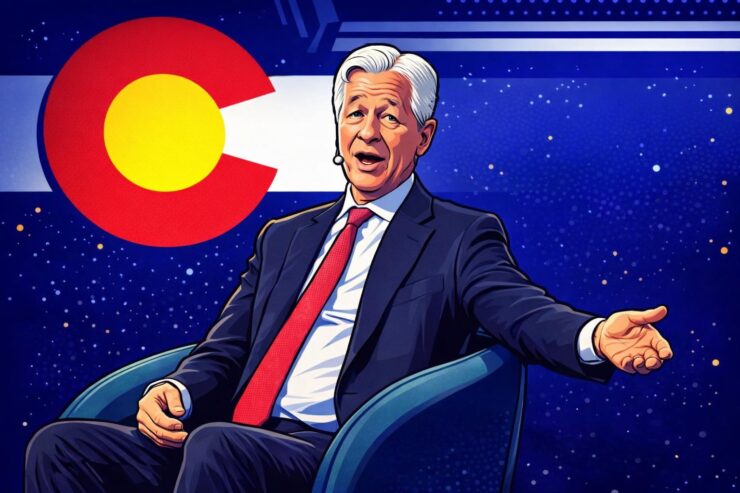
Wall Street’s relationship with the Trump administration just hit the “it’s complicated” stage. According to The Denver Post’s republish of an Associated Press report, major bank CEOs are warning President Donald Trump that his recent attacks on the Federal Reserve and the credit card industry could backfire on the economy.
The AP reports Trump previously delivered what big banks love most: tax cuts, a sharply reduced Consumer Financial Protection Bureau budget, and a deregulatory push from his bank regulators. Then—plot twist—Trump proposed a one-year 10% cap on credit card interest rates and his Department of Justice has launched an investigation into Federal Reserve Chair Jerome Powell.
So now the same industry that’s been eating well is suddenly very concerned about “institutions,” “confidence,” and “the broader economy.” Sure. Totally. No self-interest here at all.
They Loved the Deregulation… Until It Touched Their Cash Cow
Here’s what the AP lays out, in plain English:
- Trump’s “One Big Beautiful Bill” (signed in July) delivered another round of tax cuts and cut the CFPB budget by nearly half.
- Trump’s regulators pursued a deregulatory agenda that banks and large corporations “embraced.”
- Now Trump wants a 10% cap on credit card interest rates in place by Jan. 20, and it’s unclear if he’d do it through “bullying” for voluntary compliance or “some sort of executive action.”
Translation: Wall Street was fine with Trump swinging a chainsaw at the watchdog, but the second he waves a machete near the credit card machine, the CEOs sprint to a microphone like it’s a fire drill.
And yes—we get it. There are real questions about unintended consequences. But it’s hard to take the “concern” seriously from an industry that gets heartburn only when their margin takes a hit.
Robin Vince: Don’t “Shake the Foundation”… of the Bond Market
BNY CEO Robin Vince warned that going after the Fed’s independence “doesn’t seem” to accomplish affordability goals like reducing borrowing costs and mortgages, and he added: “Let’s not shake the foundation of the bond market…”
We’ll translate again: “Please stop messing with the referees while we’re still up on points.”
The AP notes big banks treat Fed independence as “sacrosanct,” even when they don’t like rate decisions. That’s the polite way of saying: Wall Street wants the Fed independent of politicians… but never independent of reality, incentives, and the financial system that’s built to make them richer.
Jamie Dimon: Respect for Jay Powell, But…
JPMorgan Chase CEO Jamie Dimon told reporters: “I don’t agree with everything the Fed has done. I do have enormous respect for Jay Powell, the man.”
That’s the corporate equivalent of: “No offense, but…”
Meanwhile, the AP reports Trump’s DOJ investigation into Powell is viewed by “many” as a threat to an institution “supposed to set interest rates free of political interference.” The article doesn’t provide details of the investigation—only that it exists and is a major reason banks are spooked.
The 10% Cap: Populism Meets the Profit Spreadsheet
Here’s the part that matters to normal people who buy groceries and get ambushed by a transmission problem:
- The AP says the average credit card interest rate is between 19.65% and 21.5%.
- Researchers at Vanderbilt University found a 10% cap would likely cost banks roughly $100 billion in lost revenue per year.
- Shares of credit card companies (American Express, JPMorgan, Citigroup, Capital One and others) fell sharply as investors reacted.
And now we arrive at the funniest part: JPMorgan CFO Jeffrey Barnum essentially says the industry is willing to go to war.
He told reporters the cap would have “the exact opposite consequence” — reducing the supply of credit and being “bad for everyone… and yes, for us, also.”
We appreciate the honesty tucked in there at the end. The mask slipped. It wasn’t “for consumers.” It was “for us.”
Swipe Fees: Trump Endorses a Bill and Calls It a “Ripoff”
Trump also endorsed Sen. Roger Marshall’s “Credit Card Competition Act,” which the AP says would “likely cut into the revenue banks earn from merchants” when credit cards are used at the point of sale.
On Truth Social, Trump wrote: “Everyone should support… [the act]… in order to stop the out of control Swipe Fee ripoff.”
Bankers when they’re extracting fees at every step of your life: market efficiency.
Bankers when someone calls the fees a ripoff: an attack on democracy.
Our Take: We’re Stuck Between Two Kinds of Games
Here’s the Colorado reality check: we’re the ones living in a state where everything costs more, fees multiply like rabbits, and “affordability” is used as a campaign prop while families keep falling behind.
So when Wall Street—fresh off tax cuts, deregulation, and a CFPB budget haircut—starts preaching stability and warning that politicians might harm consumers… we’re allowed to laugh. Loudly. Because we’ve watched this movie before: the industry profits on the way up, then demands “independence” and “confidence” on the way down.
Also: if the average credit card APR is hovering around 20%+ like the AP reports, we don’t need a PhD to understand why people feel trapped. Scott’s point lands: a surprise expense hits, the card comes out, and suddenly you’re making payments that feel like a treadmill set to “forever.”
Does a blunt 10% cap create other problems? Maybe. The AP includes the industry argument that it reduces credit supply. But what we do know—from the reporting—is the banks are already bracing because it threatens billions in revenue. Which tells you exactly where the pain point is.
Sound Off
Are the banks right that this would shrink credit and raise costs elsewhere? Or are they just mad someone finally touched the holy interest-rate printer?
Drop your take, share this with the friend paying 24.99% “because reasons,” and let’s hear it.
 Just Stop It