

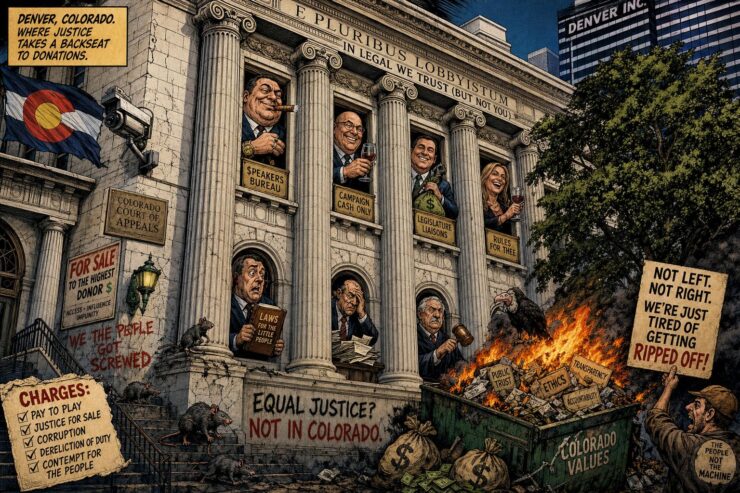
Colorado Politics dropped a Court Crawl item with the kind of dry institutional wording that should make normal people sit up straight: the Colorado legislature overruled two recent state Supreme Court decisions this session, while federal judges are dealing with government violations of court orders in immigration detention cases.
That is not just lawyer baseball. That is the machinery of government grinding its gears in public while regular citizens are still expected to obey every rule, deadline, fee, permit, notice, mandate, summons, and bureaucratic scavenger hunt the state throws at them.
Now, let’s be clear before the outrage carnival starts selling foam fingers: lawmakers changing a law after a court interprets it is not automatically a scandal. Courts say what existing law means. Legislatures can often respond by changing that law going forward. That is part of the separation-of-powers dance, ugly shoes and all.
But government actors violating a judge’s order? That is a different animal entirely. That is not “policy disagreement.” That is not “a technical fix.” That is the government being told by a court to do or not do something, then allegedly failing to comply. If proven, that is rule-of-law territory, not press-release territory.
The distinction matters because public officials love blurring lines when the blur helps them keep power. If the state Supreme Court reads a statute one way and lawmakers decide they hate the outcome, they can come back with a bill and rewrite the rules, assuming the constitution allows it. Voters can judge whether that rewrite protects the public or just rescues the powerful from an inconvenient court loss.
But when a judge issues an order, the government does not get to treat it like a strongly worded suggestion from an HOA newsletter. Court orders are not optional mood boards. They are commands backed by the authority of the judicial branch, and when the government starts playing “catch me if you can” with compliance, the whole civic bargain starts smelling like burnt wiring.
This is where the regular Coloradan question kicks in: who gets held accountable when institutions collide?
Because if you miss a court date, fail to pay a fine, ignore a summons, or blow off a state agency demand, the system will find you faster than a parking officer in downtown Denver. But when government bodies lose in court, sometimes they rewrite the law. When agencies violate orders, judges have to drag everyone back into court and ask why the hell the government thinks the rules are decorative.
That does not mean every legislative response to a court ruling is corrupt. Sometimes the court exposes a bad statute, a drafting mistake, or a conflict lawmakers need to fix. Fine. Fix it in daylight. Say plainly what the court held, what the bill changes, who gains power, who loses protection, and who pays.
But do not sell it as housekeeping if it is really a power grab wearing khakis.
And on the federal side, when judges are addressing violations of orders in immigration detention cases, the public should pay attention even if immigration politics make everyone stupid on command. The question is not whether you like the detainee, the policy, or the administration. The question is whether the government obeys courts when courts tell it no.
Colorado already has enough government-by-fog: fees disguised as progress, “technical” bills that move real power, agencies that talk like customer service while acting like landlords with badges. The last thing this state needs is a civic culture where legal limits become speed bumps for people with letterhead.
So here is the citizen takeaway: when lawmakers overrule courts, read the bill and ask who benefits. When someone calls it a “technical fix,” check your wallet and your rights. And when judges say government officials violated orders, do not shrug.
That is the moment process stops being boring and starts becoming power with its mask off.
Source: Colorado Politics

 Just Stop It