
This is not a Tina Peters fan letter. It is not a declaration of innocence. It is not another lap around the flaming Mesa County election circus.
It is a due-process grenade sitting on the courthouse floor while Colorado’s judicial class acts like nobody smells smoke.
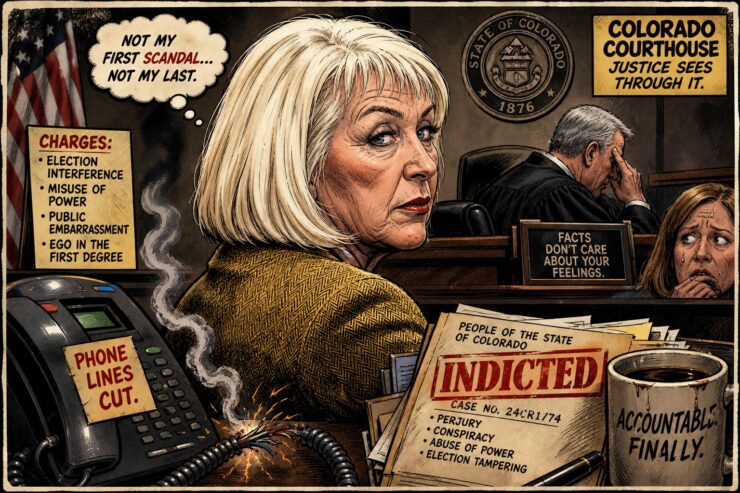
Rocky Mountain Voice reports that during Peters’ 2024 trial, a juror’s business phone lines were cut on the first Friday of trial. The juror reported it to police, spent $4,000 restoring service, went back to the jury box, and for more than a week wondered whether she was being “targeted.” The court and attorneys did not know about it until after the verdict.
That is not a shrug emoji moment.
Peters was convicted on four felony counts and three misdemeanors on Aug. 12, 2024. Weeks later, after a defense investigator recorded an interview with the juror, Peters’ lawyers asked for a hearing to investigate whether outside influence may have affected the juror. Judge Matthew Barrett rejected the request the same day it was filed. The Colorado Court of Appeals later blessed that move.
Again, nobody has to claim the juror was actually targeted.
Nobody has to claim Peters is innocent.
Nobody has to relitigate every conspiracy, indictment, argument, and scream-cloud that has followed her name around Colorado like a meth-addled parade float.
The narrow point is stronger: when a sitting juror in a politically explosive criminal trial spends 10 days wondering whether someone is messing with her because of the case, a hearing is not some luxury spa treatment for defendants. It is the basic damn safety check that keeps a verdict from smelling like burned wires.
But apparently in Colorado, when the defendant is radioactive enough, due process becomes optional paperwork.
Peters’ attorneys pointed to Remmer v. United States, the 1954 U.S. Supreme Court case that established the need to examine possible unauthorized juror contact. Rocky Mountain Voice reports they also cited later cases involving post-verdict hearings into outside influence, while arguing Colorado courts treated Rule 606(b), which limits inquiry into jury deliberations, like a concrete wall instead of a rule with exceptions for outside influence.
The Court of Appeals said Peters did not properly invoke an exception. Fine. Lawyers can fight over procedural knobs all day. That is what courthouses are apparently for when they are not turning public trust into mulch.
But the public sees the bigger thing.
A juror’s business phone lines get cut during a high-profile trial. The juror worries she might be targeted. The defense asks for a hearing. The judge says no by lunch. The appeals court says good enough. And everyone in robes expects ordinary people to stare at that timeline and say, “Yes, very confidence-inspiring, please continue guarding democracy.”
Come on.
Colorado institutions spent years telling people that election trust is sacred, fragile, and worth protecting from every possible threat. Then when an election-related criminal conviction raises a juror-integrity question, suddenly looking under the hood is too much trouble?
That is not efficiency. That is arrogance wearing a black robe and checking its watch.
If the trial was clean, a hearing helps prove it. If nothing happened, great. Put it on the record. Let the facts breathe. Let the public see that the system was careful, not allergic to scrutiny.
But when courts skip the safety check, they do not look strong. They look scared of their own dashboard lights.
The Colorado Supreme Court now has a simple test in front of it: do clean trials still matter when the defendant is politically hated, or does the system only care about appearances when the right people are watching?
Because if courts want people to trust election-related convictions, they cannot treat possible juror influence like an administrative inconvenience.
That is how institutions turn credibility into compost and then act shocked when nobody wants to eat the tomatoes.
Source: Rocky Mountain Voice

 Just Stop It