

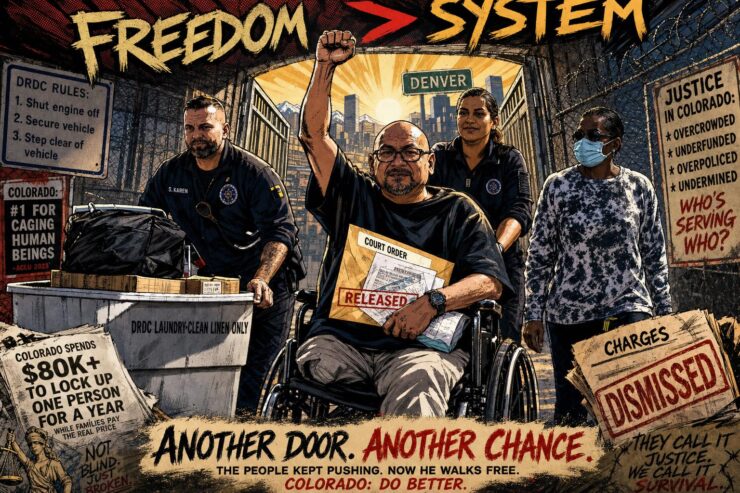
The Denver Gazette has the kind of Colorado story that should make every courthouse in the state go dead quiet: Stephen Martinez, now 58, is free after spending 27 years behind bars in a Denver baby death case tied to disputed “shaken baby” assumptions.
Twenty-seven years. Not a clerical mistake. Not a bad afternoon at the DMV. A human life put through the government grinder while the system wore a tie, spoke in solemn tones, and acted like certainty was the same thing as truth.
According to the Gazette, Martinez was convicted after four-month-old Heather Lynn Mares, the daughter of his roommate, died on Oct. 17, 1998. Martinez now says the crime never happened. Boulder attorney Jeanne Segil looked at the case and believed there was a shot at getting him released. A CU Boulder law school program helped do the work that eventually pried the door open.
Good. Credit where it is due. If attorneys and law students helped free a man after nearly three decades, that is real work, not résumé confetti.
But let’s not turn this into a glossy CU Boulder brochure with inspirational lighting and a saxophone soundtrack. The bigger story is uglier: how many official layers had to be wrong, stubborn, asleep, or too damn proud before someone outside the original machinery could force a second look?
Because this is the part the system hates talking about. When prosecutors, expert witnesses, trial courts, appeals courts, and prison paperwork all stack on top of each other, a conviction starts getting treated like a holy relic. Don’t touch it. Don’t question it. Don’t ask whether the science got shakier than a folding chair at a county fair.
And when the underlying theory involves old “shaken baby” assumptions that later come under dispute, the arrogance gets even thicker. The state does not say, “We might need to be careful here.” The state says, “We already decided,” then locks the file in a basement and hopes everyone involved retires before the truth starts making noise.
That is the terrifying part. Government can be wrong with handcuffs. Government can be wrong with expert testimony. Government can be wrong with a judge nodding along. Government can be wrong for 27 years and then, when the door finally opens, act like freedom at 58 is a customer-service resolution.
Sorry about the lost decades, sir. Please take this plastic bag of belongings and enjoy whatever is left of the world we kept changing without you.
And nobody should confuse this with minimizing the death of Heather Lynn Mares. A baby died. That is a horror no punchline should touch. The question is whether the system transformed tragedy into certainty, certainty into conviction, and conviction into 27 years of concrete without enough humility to admit science is not a magic wand just because someone says it under oath.
Colorado loves to lecture itself about reform, justice, compassion, and all the other mural words painted on the side of bureaucratic incompetence. Fine. Then ask the brutal questions. What exactly convicted Martinez? What changed? Who fought review? Who checked the science? Who is accountable when a conviction collapses after a generation?
Because normal Coloradans are expected to treat every government decision like sacred scripture while paying taxes, fees, court costs, and the moral bill for whatever the system breaks.
Twenty-seven years is not an “unfortunate outcome.” It is a life bulldozed by official confidence. And if the people who built that bulldozer cannot explain themselves, they should stop calling it justice and start calling it what it looks like from outside the courthouse: a damn machine that can eat a man alive and burp out procedure.
Source: Denver Gazette

 Just Stop It