
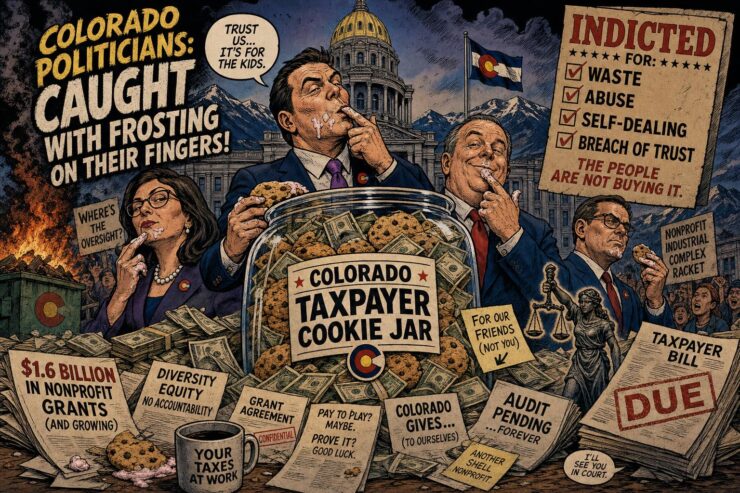
The Colorado nonprofit industrial complex just got caught with its hand in the taxpayer cookie jar, and somehow the scandal is that somebody noticed crumbs on the blazer.
Complete Colorado reports that House Bill 26-1274 passed in the final hours of the 2026 legislative session, because apparently the best time to move taxpayer money around is right before the lights shut off and everyone’s pretending they read the bill. The measure lets nonprofits awarded state-funded grants request up to 25 percent of the money in advance after the contract is executed, instead of waiting for reimbursement after spending the money.
That is not some tiny bookkeeping tweak. That is the state saying, “Here, politically connected nonprofit world, have taxpayer cash earlier.”
Then Republicans asked the obvious question: maybe sitting lawmakers who work for, run, consult for, direct, or otherwise draw income from nonprofits should not personally benefit from a law making nonprofit grant money easier to collect.
And that, naturally, caused a Capitol tantrum.
Sen. Byron Pelton, a Sterling Republican, offered an amendment to exclude sitting legislators and their family members from benefiting under the new law. It first got ruled down on a voice vote, then came back for a recorded vote and passed. Sen. Julie Gonzales, a Denver Democrat and co-founder of the Colorado Latino Forum, took a conflict-related excusal from voting. Thirteen Democrats still voted against the amendment, many of them reportedly tied to nonprofits.
This is where the gravy train started squealing like the trough had civil rights.
Nobody is roasting the food bank keeping families alive. Nobody is dunking on the shelter worker doing real work while some grant-writing goblin in a Capitol-adjacent office turns “community impact” into a revenue model.
The target is the political nonprofit pipeline — that weird Colorado machine where taxpayer money, legislative power, activist prestige, soft employment, board seats, consulting gigs, and moral superiority all get dumped into one blender and served as a taxpayer-funded smoothie of bullshit.
And when someone says, “Hey, maybe lawmakers shouldn’t vote on money systems that could benefit organizations connected to them,” the response is not calm transparency. It is outrage. It is offense. It is How dare you question our sacred do-gooding empire?
Pelton later narrowed the amendment so it applied only to elected officials, not their families. Even then, Gonzales objected on the Senate floor, asking why serving as an officer of a nonprofit should be punished when lawmakers already file annual disclosures.
Here is why: because disclosure is not a magic ethics shower.
Writing your conflict down on paper does not make it disappear. It just means the public gets to watch you stand next to the cookie jar with frosting on your fingers while insisting the kitchen inventory form is “transparency enough.”
Sen. Barbara Kirkmeyer put the sharper point on it: if someone is receiving money from an organization while also serving in the General Assembly, maybe voting on systems that help those organizations access taxpayer dollars creates a conflict problem. That should not be controversial. That should be the warm-up question before Ethics 101 starts handing out crayons.
The accidental confession came at the end: Pelton said he plans to bring a bill next year to prohibit legislators from taking compensation from nonprofits.
Fantastic. So the system is clean, but also it needs cleaning next session. Nothing suspicious here. Just a Capitol full of public servants suddenly rediscovering ethics after someone threatened to turn on the lights.
Normal Coloradans are tired of being treated like an ATM for every politically connected do-gooder racket that wants public money up front, public trust on demand, and zero suspicion when the people writing the rules know the people cashing the checks.
If the nonprofit-industrial machine is so pure, it should survive daylight.
If it cannot survive daylight, stop calling it charity and start calling it what it is: a taxpayer-funded ladle fight at the ruling-class soup line.
Source: Complete Colorado
 Just Stop It