

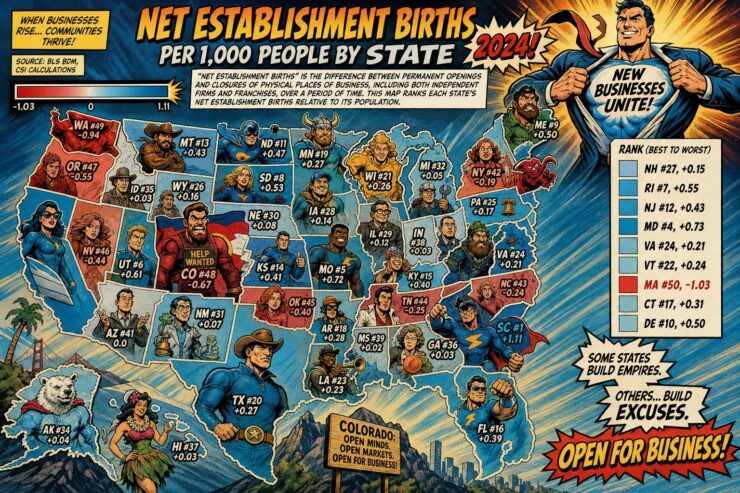
Colorado officials confirmed this week that the state remains a national leader in business creation, provided the businesses are imaginary, delinquent, leaving for Florida, or one guy with an LLC trying to write off his Subaru.
The clarification followed new reports showing Colorado ranked 48th in net business births and dead last in physical business establishment growth in 2024, while state leaders continued celebrating a surge in new business filings because paperwork is cheaper than employers.
According to the Common Sense Institute, Colorado lost a net 3,934 business establishments in 2024, with 28,121 births and 32,055 deaths, a figure officials described as “a vibrant churn ecosystem” before asking if anyone knew where Palantir went.
“We are thrilled to see so many Coloradans starting businesses in the Secretary of State’s database,” said one economic development official, staring past a boarded-up office suite. “Whether those businesses have revenue, employees, leases, customers, or a pulse is exactly the kind of negative thinking that scares away entrepreneurs.”
The state’s official optimism is supported by nearly 55,000 new business registrations in the first quarter, a number that includes large companies, storefronts, contractors, and recently laid-off people forming consulting companies after discovering rent still exists.
Business renewals also rose, delinquencies climbed, and dissolutions fell, giving Colorado a balanced economic picture in which nobody can tell whether companies are thriving, dying, late, confused, or simply waiting for their accountant to sober up.
Gov. Jared Polis reportedly took the matter seriously enough to sign a letter warning Gov. Jared Polis and other leaders that Colorado is scaring away tech companies and entrepreneurs. A source close to the governor later clarified that the governor did not necessarily agree with the letter signed by the governor during the media event attended by the governor.
“That was not a contradiction,” said a consultant close to the matter. “That was public-private partnership. The public part is the warning. The private part is pretending it was someone else’s fault.”
The Chamber of Commerce separately cited a net loss of 98 firms and 13,607 jobs since 2019, while Colorado’s labor force shrank and participation dropped to its lowest level since 2020. State officials said the falling unemployment rate remains encouraging, especially after enough people stopped looking for work to improve the math.
Meanwhile, Palantir announced it would move its headquarters from Denver to Miami, and Re/Max prepared to follow after a proposed acquisition, reinforcing Colorado’s emerging brand as a place where companies come for the mountains, stay for the press conference, and leave when the bill shows up.
Officials stressed that not all corporate operations are leaving, noting that some companies may continue maintaining “a presence” in Colorado, a term now understood to mean a forwarding address, three badge readers, and a regional vice president trapped in traffic on I-25.
Asked whether ranking below Oregon and Massachusetts on key business measures should worry policymakers, one legislative aide said the state remains focused on building a competitive economy through stakeholder engagement, regulatory innovation, affordability task forces, and whatever phrase keeps donors calm until the next ribbon cutting.
“We’re not losing businesses,” the aide said. “We’re exporting them to states with fewer meetings.”
Colorado’s new economic strategy is expected to be unveiled later this year, once officials finish registering it as an LLC.
Source: Mark Samuelson

 Just Stop It