

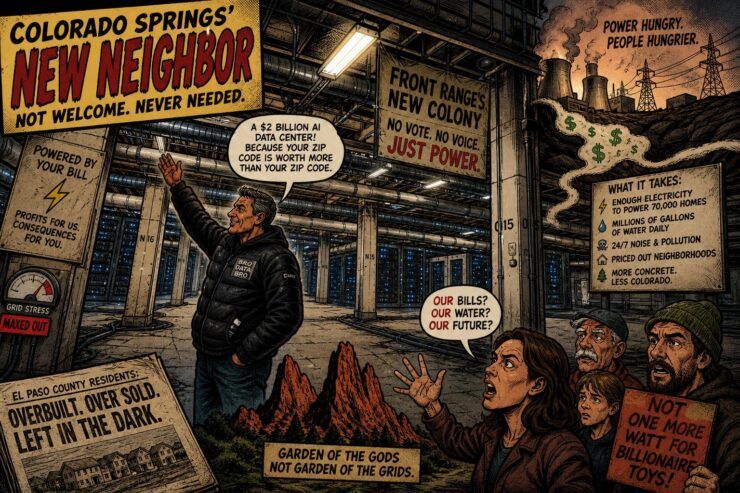
The Gazette has Colorado Springs staring at the future, and apparently the future is a giant AI data center wedged into the old Intel site off Garden of the Gods Road while everybody argues over whether it’s critical infrastructure or a high-tech leaf blower with a water habit.
Project Taurus, proposed by California-based Raeden, is being sold as the kind of infrastructure Colorado Springs needs if it wants to remain a serious military, space, and business hub. Former Mayor John Suthers says AI is the future, data centers are necessary, and Colorado Springs needs them to stay competitive.
Also, Suthers now works at Brownstein Hyatt Farber Schreck and says he has agreed to take Raeden as a client. Which is a hell of a sentence. Nothing says “public interest” quite like the former mayor emerging from the legal-consulting fog machine to explain why the giant power-sucking computer barn is actually destiny.
To be clear: data centers are not automatically evil. They are infrastructure now. Like water, sewer, streets, and power, except with more servers, fewer potholes, and a much better LinkedIn presence. Colorado Springs is a military town, a space town, and increasingly a data town. Peterson, Schriever, the defense world, satellite traffic, AI processing — none of that runs on inspirational murals and chamber-of-commerce confetti.
But residents are not crazy for asking questions before the city lets another big facility hum away next to neighborhoods. People near Chelsea Glenn remember the old bitcoin-mining circus from 2018 to 2020, when the building generated persistent noise complaints and the city’s response was basically, “Technically, this misery fits inside the ordinance, so enjoy your federally compliant headache.”
That is exactly why “trust us” is not a regulatory plan. It is a lullaby for suckers.
Raeden’s Jason Green says the old noisy fans will be removed, the facility will use a closed-loop cooling system, and water use will be a one-time 200,000 gallons instead of some evaporative cooling nightmare. Good. That is the conversation normal adults should be having: prohibit evaporative cooling, require real noise and vibration mitigation, define enforceable standards, and make the developer prove it before the ribbon-cutting photos and economic-development backslaps begin.
Because here is the scam Colorado has perfected: officials call something “growth,” developers call it “investment,” consultants call it “innovation,” and residents get handed the utility bill, the traffic, the noise, and a pamphlet about how lucky they are to live near progress.
Project Taurus is reportedly cleared for up to 50 megawatts. That is not a toaster. That is not your neighbor leaving Christmas lights on until February. That is serious load on a system where regular people are already getting smacked with peak-hour rates between 5 and 9 p.m., otherwise known as “the only time working families are actually home.”
So yes, if a data center wants giant-load power, utilities should charge giant-load tariffs and sink that money back into generation and the grid. Not into some bureaucratic incense burner labeled “resilience.” Into actual capacity, actual transmission, actual protection for ratepayers. If the data center gets the benefit, the neighborhood should not get the invoice.
And spare us the two usual clown options: the booster cult that chants “jobs” until their eyes glaze over, and the activist panic squad that treats every server rack like it personally murdered a trout. Suthers himself says Project Taurus may create 60 to 100 high-paying jobs directly. That’s fine, but it’s not an employment messiah. The bigger argument is infrastructure for the military and future employers. Then say that plainly. Don’t sell a backbone as a jobs parade.
Colorado Springs needs to be aggressive about the future without becoming stupid about the present. That means open meetings big enough for the public to actually attend, honest answers, binding rules, no evaporative cooling, serious noise controls, and power agreements that fortify the grid instead of mugging the ratepayer.
Data centers may be critical infrastructure. But critical infrastructure still needs a leash, a meter, and a city government with enough spine to tell the shiny new tech god: welcome to Colorado Springs — now shut up, pay your share, and don’t screw the neighbors.
Source: The Gazette

 Just Stop It